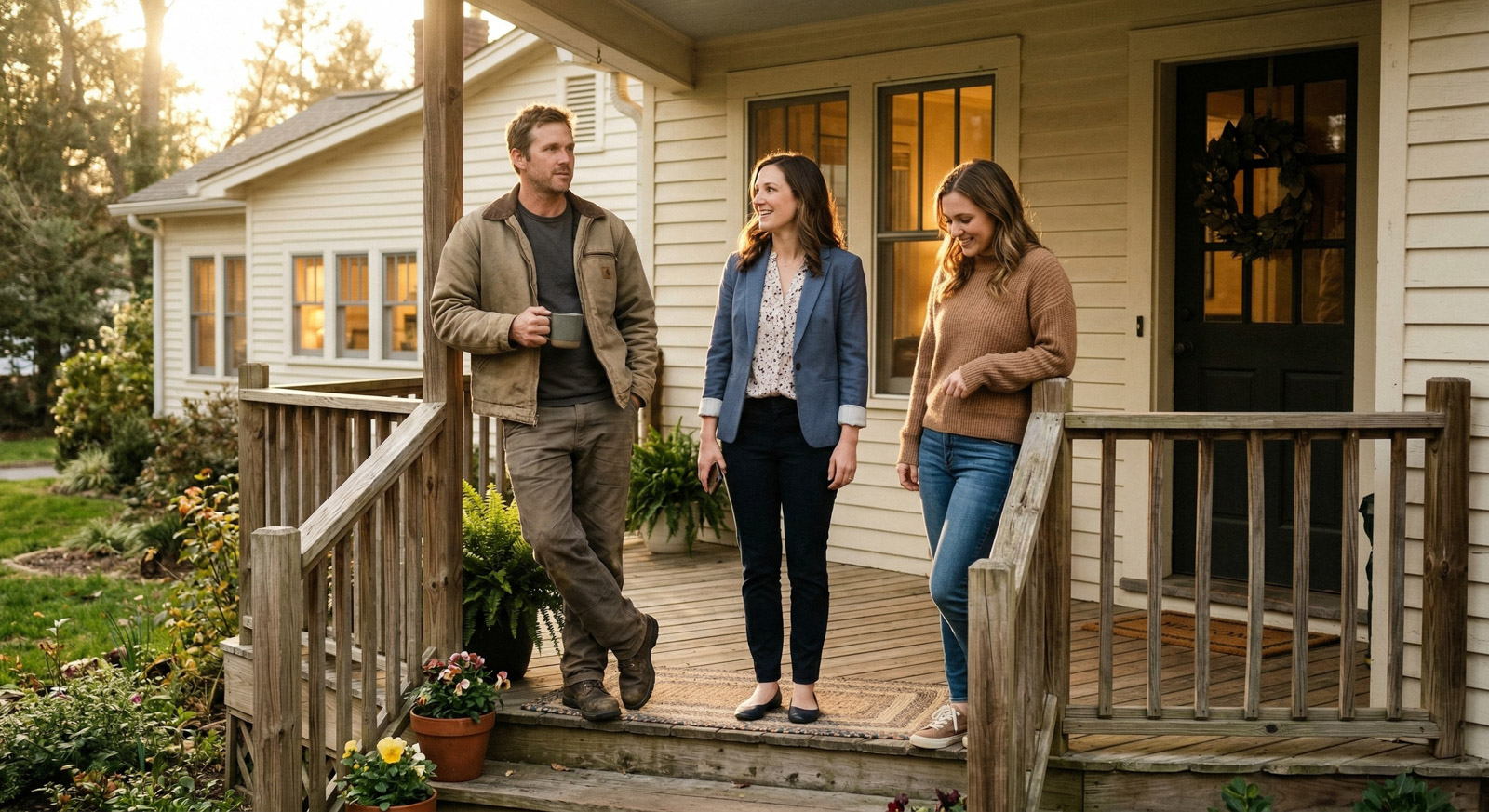
You raised them. You drove them to school. You helped with homework, dried the tears, sat through every recital. In every way that matters, they're yours.
But the law doesn't see it that way.
In the vast majority of U.S. states, step-children have zero inheritance rights when a step-parent dies without a will. None. The child you've parented for fifteen years is treated the same as a stranger under intestacy statutes. Meanwhile, a biological cousin the deceased never met could have a stronger legal claim to the estate.[1]
This is the step-child blind spot — the gap between how your family actually works and what the legal system recognizes. If you're part of a blended family and you haven't addressed this explicitly, your estate plan has a hole in it. Let's close it.
The Scale of the Problem
Blended families aren't edge cases. According to Pew Research Center — in the most recent comprehensive national study on the topic (2011) — 42% of American adults have at least one step-relative: a step-parent, a step-sibling, or a step-child.[2] Roughly 13% of adults in the U.S. are step-parents. No comparable nationwide survey has been conducted since, but Census Bureau data confirms blended family structures remain prevalent — in 2021, more than one in five cohabiting couples had children with multiple partners.[3] Demographers widely expect the percentage of Americans with step-relatives has grown since 2011.
Yet the inheritance laws most states rely on were written for a world of first marriages and biological children. The legal framework hasn't caught up with the families we actually have.
Here's what happens when a step-parent dies without a will in most states: the estate passes to the surviving spouse first, then to the deceased's biological or legally adopted children. Step-children are not in the line of succession. They are invisible.
Even under the Uniform Probate Code — a model law adopted in some form by roughly 18 states — step-children only inherit as a last resort, after all biological descendants, ancestors, and collateral relatives have been exhausted.[4] In practical terms, this means a step-child inherits from a step-parent's estate only if the step-parent has literally no other living relatives. That's not a safety net. That's a statistical improbability.
California is one of the few states with a narrow exception: a step-child may inherit under intestacy if the relationship began during childhood and there is clear and convincing evidence the step-parent would have adopted the child but was legally unable to do so.[5] But "clear and convincing evidence" is a high bar, and litigating it after someone has died is expensive, uncertain, and emotionally devastating.
Why "I'll Just Leave Everything to My Spouse" Doesn't Work
The most common blended-family plan is no plan at all. Both spouses assume everything will go to the survivor, and the survivor will "do the right thing" for all the kids.
This sounds reasonable. It almost never works the way people imagine.
Here's the problem: once you leave everything to your spouse, it's their money. They have no legal obligation to pass anything along to your children from a prior relationship. If your spouse remarries after you die, their new partner's family could end up with assets you intended for your kids. If your spouse's relationship with your children deteriorates — which happens more often than anyone likes to admit — your children could be shut out entirely.
“"The number one mistake in blended family estate planning is assuming your surviving spouse will distribute assets the way you would have. Love is not a legal document." — American College of Trust and Estate Counsel[6]”
And then there's the scenario nobody wants to think about.
The Simultaneous Death Problem
What happens if both spouses die in the same accident — a car crash, a plane going down? Under the Uniform Simultaneous Death Act, each spouse's assets are distributed as if they survived the other. In a first-marriage family, this usually means everything flows to the same set of children. In a blended family, it can mean each spouse's assets go exclusively to their own biological children — and any step-children who weren't legally adopted or specifically named get nothing from either estate.
If you and your spouse each have children from prior relationships plus shared children together, this scenario creates three groups of kids with potentially three different outcomes. Your shared biological children may inherit from both estates. Your step-children may inherit from neither.
Without explicit planning, simultaneous death in a blended family can produce results that would horrify both parents. This is exactly the kind of edge case you should be mapping out. If you haven't already, our complicated situations guide walks through scenarios like this one.
Four Ways to Actually Protect Your Step-Children
There is no single right answer here. What works depends on your family's dynamics, the ages of the children, and the relationship with the other biological parent. But here are the four main tools, ranked roughly from most to least legally robust.
1. Adoption
Legal adoption gives a step-child the identical inheritance rights of a biological child — full stop.[5] Once adopted, a step-child is an heir under every state's intestacy laws, is automatically included in class gifts ("I leave my estate equally to my children"), and has standing to contest a will that excludes them.
The catch: Adoption requires terminating the other biological parent's parental rights. If the other parent is alive and involved, this is often impossible — and shouldn't be forced. Adoption works best when the other biological parent is deceased, has abandoned the child, or voluntarily consents.
If adoption fits your situation, it's the strongest protection you can give.
2. A Trust with Specific Provisions
A revocable living trust — or a testamentary trust created within your will — lets you name step-children as explicit beneficiaries and spell out exactly what they receive, when, and under what conditions.
The key advantage of a trust is control beyond the grave. You can direct that:
- Assets are held for a step-child's benefit until they reach a certain age.
- Your surviving spouse receives income from the trust during their lifetime, but the principal is preserved for your children (including step-children you've named).
- A professional trustee manages the assets if you're concerned about family conflict.
A QTIP trust (Qualified Terminable Interest Property) is particularly useful for blended families. It provides for the surviving spouse during their lifetime while guaranteeing that the remaining assets pass to the beneficiaries you choose — not the beneficiaries your spouse might choose after you're gone.
3. Explicit Will Provisions
At minimum, your will should name every child you want to inherit — biological and step — by name. Don't rely on general language like "my children" because courts in many states interpret that phrase to mean only biological and legally adopted children.
Be specific. "I leave 25% of my residuary estate to Jordan Smith, my step-child" leaves no room for interpretation.
Also consider including a no-contest clause (also called an in terrorem clause). This discourages any beneficiary from challenging the will by providing that anyone who contests it forfeits their share. These clauses aren't enforceable in every state, but where they are, they add a layer of protection. If family conflict is already present, see our guide to estate planning for estranged families for additional safeguards.
4. Beneficiary Designations and POD/TOD Accounts
Life insurance policies, retirement accounts (401(k), IRA), and payable-on-death bank accounts pass outside of your will. Many people forget this. You can name a step-child as a direct beneficiary on any of these accounts, and it doesn't matter what your will or trust says — the beneficiary designation controls.
This is one of the simplest and most immediate steps you can take. Review every account that has a beneficiary designation and make sure it reflects your actual family, not just your legal family.
The Fairness Question
Blended families force a question that first-marriage families can sometimes avoid: what does "fair" actually mean?
Does fair mean equal shares for every child? Does it mean accounting for what each child has already received from their biological parents? Does it mean the children you raised get more than the children who lived primarily with the other parent?
There is no universal answer. But avoiding the question doesn't make it go away — it just means the answer gets decided by a probate court instead of by you. If you're wrestling with how to divide things equitably across a blended family, The Fairness Engine offers a framework for thinking through these decisions before they become conflicts.
The Heirloom Approach
One thing that makes blended family planning especially difficult is keeping track of everything — who is named where, which accounts have which beneficiaries, what promises you've made to which children. When the pieces live in separate documents across different attorneys and financial institutions, things fall through the cracks.
Heirloom was built for exactly this kind of complexity. It gives you a single place to map your full family structure — biological children, step-children, shared children — and make sure every person is accounted for in your plan. No one falls through the gap between how your family feels and what the law recognizes.
What You Can Do This Week
You don't need to overhaul your entire estate plan in one sitting. But you do need to start. Here are five concrete steps you can take this week:
Pull your beneficiary designations. Log into every account that has a beneficiary — life insurance, 401(k), IRA, brokerage accounts, bank accounts with POD — and write down who is currently named. If your step-children aren't listed anywhere, that's your blind spot.
Check your will for the word "children." If your will uses general language like "my children" or "my descendants" without naming step-children specifically, a court may exclude them. Flag this for your attorney.
Talk to your spouse about the "what if we both die" scenario. It's uncomfortable. Do it anyway. Decide together what should happen to each set of children if neither of you survives. Write it down, even informally, before your next meeting with an attorney.
Research whether adoption makes sense for your family. If the other biological parent is deceased or uninvolved, adoption may be the simplest and most powerful protection you can offer. A family law attorney can tell you what's required in your state.
Start documenting your intentions. Even before you update legal documents, write down what you want to happen and why. Record which children you consider yours — legally or not — and what you want each of them to receive. This record can guide your attorney, reduce family disputes, and serve as evidence of your wishes if anything is ever contested.
The legal system wasn't designed for your family. That doesn't mean your family has to suffer for it. Close the blind spot. Name the people you love. Put it in writing.